We acknowledge Australia’s Aboriginal and Torres Strait Islander peoples as the Traditional Custodians of the land on which we work and live and give respect to their Elders, past and present.

Read our Statement of Reflection

Your Cart

Your cart is empty right now...

Discover what's on
Your Stuff
Lists
No lists found
Create list
List name
0 Saved items
Updated: a few seconds ago
Getting Started
Get started with Your Stuff

A free Your Stuff account allows you to save, list and share your favourite collection items and articles. This account will give you access to Your Stuff, NFSA Player and Pro. You will need to create an additional account for Canberra event tickets.

Confirm
Skip to main content
National Film and Sound Archive of AustraliaNational Film and Sound Archive
National Film and Sound Archive of Australia
National Film and Sound Archive
National Film and Sound Archive of Australia
National Film and Sound Archive

Spirits in the Material World

When radio took off in the 20th century so did the belief that the airwaves offered the chance to communicate with spirits – an anxiety that cast a shadow over radio’s inception story and still endures with new technological advancements today.

23 November, 2023
3 minute read

When radio took off in the 20th century so did the belief that the airwaves offered the chance to communicate with spirits – an anxiety that cast a shadow over radio’s inception story and still endures with new technological advancements today.

This feature is part of the NFSA's Radio 100 celebrations.

By Alexandra Heller-Nicholas

The Genteel Occulists

Husband-and-wife mentalists, Sydney and Lesley Piddington, circa 1940s

The Piddingtons, mentalists Sydney and Lesley Piddington, c1940s.

Early Australian radio stars Lesley and Sydney Piddington looked the picture of suburban civility, but the couple were extraordinary on many counts.

They met through a mutual friend who had spent time in a prisoner-of-war camp with Sydney during the Second World War, and it was here that the young Piddington first developed his flair for mentalism to entertain his fellow prisoners. As a husband-and-wife act, the Piddingtons together refined Sydney’s tricks to dazzle postwar audiences with theatrical displays of telepathy, hypnosis and other psychic feats.

The Piddingtons were a cultural sensation, and the media-savvy couple quickly adapted their live theatrical performance to radio to reach a much wider audience. With 3KZ’s The Piddington Show, their signature brand of genteel occultism was ideally suited to radio, the mass communication medium du jour before television was introduced to Australia in 1956.

Invalid url

Excerpt from The Piddington Show, 3KZ Radio, 1947.

National Film and Sound ArchiveRHNW2BM4

Communing with the dead?

The Piddingtons' radio success reflected what, by the mid-20th century, was already established as a strong association between new media technologies and the supernatural. The language of the mystical and the fantastic provided a concrete, enduring way to understand the increasing presence of mass communications in daily life. The rise of telecommunications coincided with the spread of spiritualism in particular, and both at their heart shared the thrilling possibility of new ways for humans to connect.

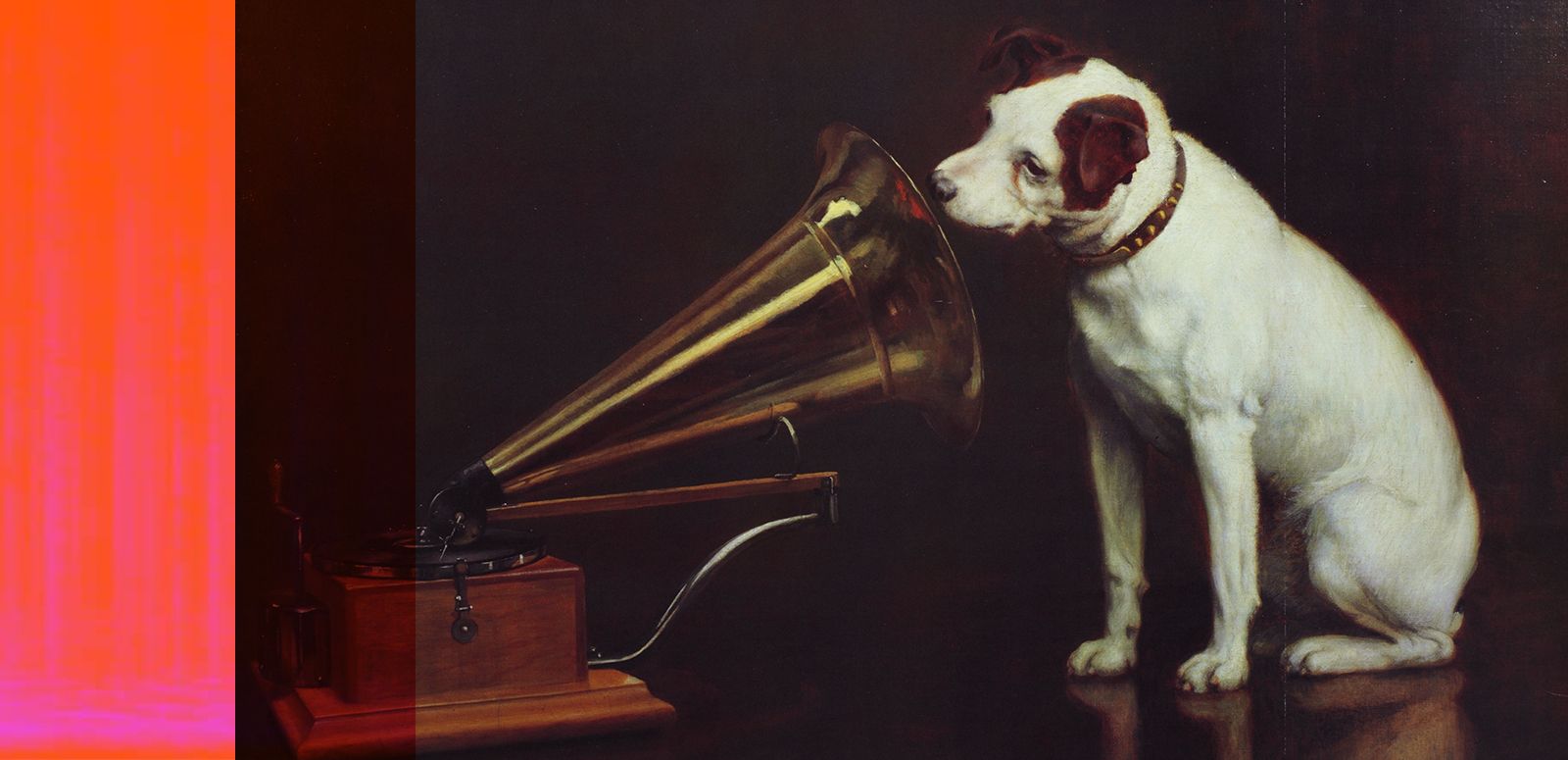
While electronic media conquered space as it instantly spread news and entertainment across its networks, spiritualism, too, promised another exciting advancement in communication through its promise of linking the living with the dead. These were hardly niche concerns, and famous inventors such as Thomas Edison – who brought us the phonograph, the motion picture camera, and the incandescent light bulb – also dabbled in experimental technologies that would allow users to connect to the realm of the spirits. Even little Nipper – the mascot terrier closely associated with the His Master’s Voice record label – was broadly understood as listening to the sound of his dead master in the famous promotional painting that shows him sitting next to a gramophone.

Associations between the spirit world and electronic sound recordings aren’t confined to history, as a quick search of 'electronic voice phenomenon' on YouTube reveals. EVP, a concept popularised by Latvian parapsychologist Konstantīns Raudive in the 1970s and 1980s, refers to sounds ‘hidden’ behind other sounds on audio recordings like radio broadcasts. EVP proponents believe these shadow sounds – usually human voices – are captured from the beyond.

The emerging possibilities of AI are a vast evolution from early radio, but the persistent promise of supernatural communing persists, be it in language models like ChatGPT to simulate conversations with the deceased or image-generating programs like Midjourney to approximate present-day photography of the long departed. Technology changes – becoming smaller, faster, more powerful – but the human urges driving it are eternal.

Alexandra Heller-Nicholas is a film critic and author who has published nine books on cult, horror and exploitation cinema.

Return to Radio 100 Chapter 1

Main image: Print of the painting His Master's Voice by Francis Barroud, 1898–99. NFSA title: 661097

Collections to explore

  • Radio 100

  • 1940s

  • The Piddingtons

  • Start your own collection

    A free Your Stuff account allows you to save, organise and share your favourite videos, audio and stories.

More in Stories+

Personalized your experience

Save, create and share

With NFSA Your Stuff
