We acknowledge Australia’s Aboriginal and Torres Strait Islander peoples as the Traditional Custodians of the land on which we work and live and give respect to their Elders, past and present.

Read our Statement of Reflection

Your Cart

Your cart is empty right now...

Discover what's on
Your Stuff
Lists
No lists found
Create list
List name
0 Saved items
Updated: a few seconds ago
Getting Started
Get started with Your Stuff

A free Your Stuff account allows you to save, list and share your favourite collection items and articles. This account will give you access to Your Stuff, NFSA Player and Pro. You will need to create an additional account for Canberra event tickets.

Confirm
Skip to main content
National Film and Sound Archive of AustraliaNational Film and Sound Archive
National Film and Sound Archive of Australia
National Film and Sound Archive
National Film and Sound Archive of Australia
National Film and Sound Archive

Staff Profile: Maryanne Doyle

From Artist to Archivist

Radio Archivist Maryanne Doyle speaks about her days in improvisational theatre, her time at Gorman House and what she loves about working with the NFSA radio collection.

Written by Emily George
01 March, 2016
4 minute read

Maryanne Doyle, Radio Archivist at the NFSA, has always looked for ways to bring various art forms together. From working in theatre, co-creating a fringe arts festival, participating in what is commonly referred to by writers as a ‘golden period’ for the Canberra performing arts scene, to her current role at the NFSA, Maryanne’s journey has been a series of artistic experiments.

Theatre, fringe and Gorman House

After studying an Arts Degree at the ANU in Canberra, Maryanne moved to Adelaide where she came into contact with the Fools Gallery Theatre Company – a Canberra group who were on tour in South Australia. She immediately became interested in working with them, and helped with the set dressing for one of their productions. Fools Gallery was an experimental company based at the Childers Street Theatre in Canberra, whose performances were created in a process that began with research and improvisational workshops. The theatre’s director, Carol Woodrow, would sit, watch and document the characters and dialogue that were created from the improvisational process. From this material a rough draft developed, followed by the creation of a script.

The period in which Maryanne was working with Fools Gallery out of Gorman House is now referred to as the ‘golden period’ because of the many arts groups – theatre, dance and visual arts – that were active in Canberra during this time, and the creative fluidity that dominated the era.

She was part of the group that organised a fringe festival in Canberra in 1989 in order to expand the arts community. She explains that ‘there was a focus on providing opportunities for local performers and artists, and there was a sense of community, of sharing resources and making connections between different art forms’.

A woman wearing a bright pink jacket standing next to the open passenger door of a car and smiling.

Other theatre groups that Maryanne worked with included the Performing Arts Cafe and Women On A Shoestring. During this time she also worked as a casual employee at the NFSA after making connections through the arts scene with other people who worked at the NFSA.

At the NFSA she helped to catalogue various films including newsreels. Her father, a keen boxing fan, helped identify the boxers in newsreels of the 1940s and 1950s.

She also entered database information about films by Howard Hughes, an Australian photographer with the Australian Museum. Hughes produced over 25 documentaries, such as Dugong Dugong, Mimona’s Basket, The Man’s Spear, The Boomerang and Central and North-West Australia. Maryanne remembers being frequently distracted from the task of winding through his films by the beautifully composed shots.

From the ABC back to NFSA

During the 1990s Maryanne worked for the national broadcaster in the ABC Archives in Sydney. She assisted in selecting ABC items for archiving, sourced vision for various programs including Lateline and catalogued radio and television programs.
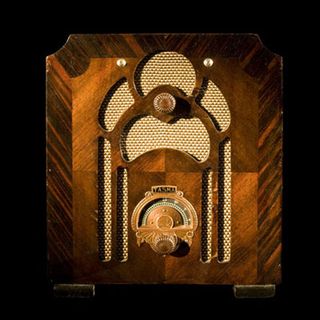
A wooden Tasma radio received from the 1930s.

Tasma radio receiver, c1930s

Her current role as a radio archivist requires her to work at building the NFSA collection of radio recordings from commercial and community stations, as well as photos, production papers, memorabilia and scripts. This includes many items from the 1940s, such as radio serials and live performances held in analogue formats which require digitising in order to preserve them.

Maryanne notes that ‘it’s a balancing act to find efficient ways to collect and to ensure we are preserving significant material as well as a range of representative programs. The archive aims to observe how radio is broadcast and distributed and try to find ways to keep up to date with changes in technology.’

My favourite things in the collection

Her favourite aspect of working with the collection is that ‘it’s exciting to discover an aspect of radio that does not appear to have been previously analysed or discussed in any detail.’

A good example is the series of interviews that Binny Lum conducted in the 1960s. The entire collection came to light through a donation after Binny’s daughter Sharon Terry wrote an obituary detailing her mother’s career. Binny Lum interviewed many famous personalities from the 1960s including Barbara Streisand, Brett Whiteley, Fred Astaire and The Beatles, and her conversational, informal style led to spontaneous, entertaining and interesting interviews.

Listen to Maryanne’s favourite sound recordings in the collection, Binny Lum’s interviews on SoundCloud:

This staff profile was published in March 2016 while Maryanne was a Radio Archivist at the NFSA.

Collections to explore

  • Start your own collection

    A free Your Stuff account allows you to save, organise and share your favourite videos, audio and stories.

More in Stories+

Personalized your experience

Save, create and share

With NFSA Your Stuff