WARNING: this article contains names, images or voices of deceased Aboriginal and Torres Strait Islander people.
Jimmy Little
1937‑2012
Brenda Gifford pays tribute to Jimmy Little, a true gentleman and legend of the Australian music industry.
Written by Brenda Gifford
03 April, 2012
3 minute readLatest
- Deep DivesThe National Songbook


 ArticlesNAIDOC Week: 50 Years of Deadly
 Deep DivesAfter Dark


A true gentleman and artist, Jimmy Little’s contribution to the Australian music industry and Indigenous music is immeasurable. Brenda Gifford knew not only the myth, but also the man.

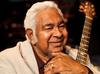
Jimmy Little and his Fender acoustic, 1965. Photo courtesy of the artist. NFSA title no: 358986
Jimmy Little was a legend within the Aboriginal community. In the mid-1980s I had the pleasure of teaching music with Jimmy at the Eora centre in Redfern; I remember him as a gentleman who was only too happy to share his knowledge of music and the music industry with young Aboriginal musicians. He was one of our greats.
A Yorta Yorta man, he was born James Oswald Little in 1937, to a family of entertainers. His parents belonged to a performance troupe from the Cummeragunja mission, which used to travel to neighbouring missions and towns, re-enacting scenes from popular American movies, as well as traditional dances.
Jimmy became a popular mainstream recording artist at a time when there was a lot of discrimination against Indigenous Australians. Performing mainly in the country and gospel styles, he rose to mainstream stardom in 1963 with his hit song Royal Telephone. The track remained in the Top 5 of the charts for 18 weeks, selling over 75,000 copies and earning him three gold records.
In 1995, Jimmy released Yorta Yorta Man, his first album since 1980. This was followed by Messenger in 1999, which was met with critical acclaim and received numerous awards. Jimmy received a Deadly Award for Single of the Year and the ARIA Award for Best Adult Contemporary Album.
Jimmy showed his commitment to improving the welfare of Indigenous Australians through his work in Indigenous health in rural communities. He established the Jimmy Little Foundation in 2006 to raise money to supply dialysis machines to remote communities. He was actively involved in the work of the foundation and appeared in charity performances.
Jimmy received the Red Ochre Award from the Australia Council in 2003 and was made a Member of the Order of Australia (AO) in 2004. He played an important role in the history of Indigenous music: he was one of the first Indigenous Australians to write, perform and release a song, and to make a recording featuring an all-Aboriginal back-up band. He was widely admired and respected within the music community, as explained by Indigenous musician Archie Roach in the 2003 documentary Jimmy Little’s Gentle Journey: ‘He was a hero, he was our first pop star. Talking about the Aboriginal community, he was our first pop idol.’
The NFSA holds copies of Jimmy’s catalogue, from his first release – the 78 rpm single Mysteries of Life / The Heartbreak Waltz (1956) – to his thirty-fourth and final album, 2004’s Life’s What You Make It.
More by Brenda
- Frank Yamma oral history21 February, 2013
Collections to explore

In memoriam

Obituaries


First Nations Musicians
Start your own collection
A free Your Stuff account allows you to save, organise and share your favourite videos, audio and stories.