
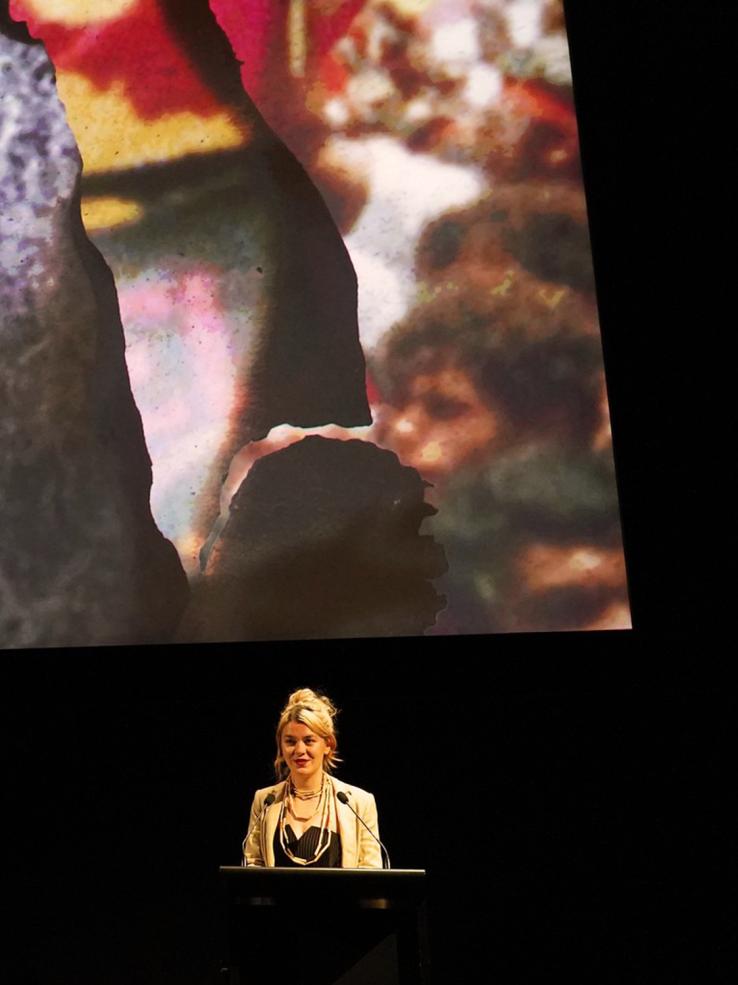
Brenda L Croft interviews Jazz Money at the ACT premiere of WINHANGANHA at the NFSA's Arc Cinema, 15 November 2023.
We acknowledge Australia’s Aboriginal and Torres Strait Islander peoples as the Traditional Custodians of the land on which we work and live and give respect to their Elders, past and present.
WINHANGANHA (Wiradjuri language: Remember, know, think) is a lyrical journey of archival footage and sound, poetry and original composition.
Commissioned by the National Film and Sound Archive of Australia (NFSA), it examines how archives and the legacies of collection affect First Nations people and wider Australia, told through the lens of acclaimed Wiradjuri artist Jazz Money.
Please contact us directly if you would like to discuss any of the content included in WINHANGANHA: FirstNationsFeedback@nfsa.gov.au
For screening enquiries, contact access@nfsa.gov.au
WINHANGANHA is classified M (Mature).
Please be advised that this page contains names, images and voices of deceased Aboriginal and Torres Strait Islander people.
Since it premiered in Sydney in November 2023, WINHANGANHA has continued to screen at festivals and other venues in Australia and internationally.
Trailer for WINHANGANHA, 2023.
WINHANGANHA was born from a desire to make sense of the archival inheritances that shape our present realities. Across a two-year period working closely with the NFSA collection, Jazz Money sifted through and reflected on the institution's extensive collections of works made by and about First Nations Australian people.
Through film, television, audio and music recordings collected since the advent of these technologies, the film is a poem in five acts that attempts to acknowledge the horrors, joys and beauties held within the archive.
The film questions power and position, storyteller and the stories told. It includes original poetry written and performed by Jazz and an original score by Filipino-Aboriginal rapper and composer DOBBY (Rhyan Clapham).
WINHANGANHA is centred upon the belief that it is our own bodies that are the truest archive of our experience, and that First Nations bodies tell a powerful story of sovereignty and resistance.
And while First Nations bodies have been documented, mythologised, degraded and catalogued and stored within the colonial gaze of archive, these bodies, these people, have danced and sung and marched and are utterly whole, beyond what can be held in these collections. The film asks how we will create new futures through that which we inherit.
Where to watch WINHANGANHA:
WINHANGANHA is available to rent now on Fanforce TV
WINHANGANHA is available to stream now on DocPlay
Jazz Money reflects on her feature-length examination of how archives and the legacies of collection affect First Nations people and wider Australia.

Audiences reflect on family history, community memory and Country in WINHANGANHA.
Watch a conversation between Jazz Money and the NFSA’s Senior Manager First Nations Engagement, Gillian Moody.
Filmed in August 2021, during the two-year development of WINHANGANHA, they discuss some of the ideas behind the film, the process of discovery in the archive, and how the project is progressing during production.
Filmmaker Jazz Money in conversation with the NFSA's Gillian Moody about WINHANGANHA (2023) in August 2021, during the development of the project.
Nothing compares to the immediacy of watching a film with an audience and experiencing their reactions first-hand. Hear the audience responses from special screenings of WINHANGANHA, both internationally and within Australia – including the GARMA Festival in remote North-East Arnhem Land and the Harvard University Ancestral Futures Symposium in Cambridge, USA.

Screenings from Arnhem Land to Harvard revealed powerful audience connections to the film.
Palawa writer Alice Bellette responds to Jazz Money's poetic film, which reclaims images and memories of First Nations people residing in archival collections.
Learn more about the artists behind WINHANGANHA.

Jazz Money is a Wiradjuri poet and artist whose practice is centred in poetics to produce works that encompass installation, performance, film and print. Their multi-award winning writing and art has been presented, performed and published nationally and internationally.
Jazz’s first poetry collection, the best-selling how to make a basket (UQP, 2021), was the 2020 winner of the David Unaipon Award. Their recently released second collection mark the dawn (UQP, 2024) is the 2024 recipient of the UQP Quentin Bryce Award. Trained as a filmmaker, Jazz’s first feature film is WINHANGANHA (2023), commissioned by the National Film and Sound Archive.
Photograph: Anna Hay
WINHANGANHA was born from a desire to make sense of the archival inheritances that shape our present realities. I wanted to tell a story of how these archives affect the lives of First Nations people today through complex and intersecting ways.
WINHANGANHA is centred upon the belief that it is our own bodies that are the truest archive of our experience, and that any documentation is only ever an approximation of the person doing the gazing – not the gazed. Our stories exist far beyond the colonial gaze.
Over the past two years I have spent many hundreds of hours sifting, sorting and unravelling a fraction of the Aboriginal and Torres Strait Islander content held in the NFSA collection.
I have watched and listened to creations exclusively pertaining to the depictions of our people held within those archives for days and weeks and months on end, but I cannot claim to have seen much at all. It would take a lifetime to begin to unravel what has happened within the cameras and microphones and cutting rooms of this continent. WINHANGANHA is one gesture towards understanding.
The film attempts to reconcile with archives as non-neutral places loaded with the desires of those who do the collecting and archiving, which in Australia has been an overwhelmingly white colonial endeavour into myth making. And while so much of the creation and application of the archive has been rooted in violence, I believe that we can undo some of that violence by returning to these collections, by understanding how they were made and honouring the people and Country depicted within.
The collections record a link to our selves and our stories. Working with archival footage has led me to consider the relationship between our recorded knowledges, and how we create new futures through that which we inherit. Film and television play a critical role in how a society understands itself, particularly in the way they portray the myths of self that eventually become enmeshed with reality.
In creating WINHANGANHA it was important to me that it celebrated Aboriginal and Torres Strait Islander protest and resistance, both to material dispossession and also in the creation of film, television and music that centres our experiences. And while protest is the turning point within the film, it is love and joy that is the overall message. That despite the injustices of the past and present, we continue to exist with love and pride in bodies that dance and march and sing and tell stories.
The film is for all audiences. It was made with an understanding that it would be seen by people who live outside Australia and beyond the context of this place, and so it attempts to frame that history. Yet the priority audience is mob to have a film that reckons with the horrors of archive, but one that celebrates our lives despite and within those depictions.
— Jazz Money
Jazz Money is renewing Australia's audiovisual history, and centralising dance, performance, gathering and protest.
Jazz Money talks about WINHANGANHA on Awaye! in November 2023.
As part of their research and creative response to the digital collection, Jazz shares here their connection to, and reflection on, three pieces of content: the 1971 Nicolas Roeg feature film Walkabout, the Australian Tourist Commission's 1980s international campaign featuring Paul Hogan, and Australia’s first ‘adults only’ soap, Number 96.
Read Australian icons, classics and the everyday of archive: a Triptych by Jazz Money

DOBBY is a true force of nature, with his electrifying live performances leaving audiences spellbound.
As a rapper, drummer, composer and producer, the ARIA Award-winning artist brings a dynamic and powerful energy to his live shows delivering an experience like no other. Proudly identifying as a Filipino and Aboriginal musician, DOBBY's roots run deep in the Murrawarri and Ngemba lands of Weilmoringle and Brewarrina, NSW.
Photograph: Luke Currie-Richardson
I was truly inspired by sis Jazz Money’s creative vision of WINHANGANHA. Without any real discussion of structure or tone at all, Jazz and I were intuitively linked in how we wanted to portray this story.
By its nature, the film travels seamlessly between varying sources of footage, be it sports, film and television, historic archive, dance etc. Thus, the viewer’s understanding of 'time' is essentially here and now. What happened before, still exists within us and within the collective narrative. This is inherently a Blakfella way of storytelling.
I wanted to mirror this story structure in my score, and reflect the different layers of our Culture and history.
There are some really beautiful moments in the film. A highlight for me is the amalgamation of Blakfella movement: boxing, skipping, running, surfing, swimming. I wanted to bring meaning, particularly urgency and dedication, to our movement. Every motion, every gesture we make, is watched under the gaze of colonial Australia. We are often judged, often ridiculed, yet simultaneously we are celebrated. This scene speaks to me deeply in this way.
The weapons scene is another personal favourite of mine, where Jazz has orchestrated various footage of us mob carrying and using weaponry. I felt a great sense of satisfaction in bringing my musical flavour to this scene; it’s a good mix of orchestral score and hard-hitting hip-hop, one that matches an energy of vengeance. Everyone needs to sit and watch this scene, and reflect upon the ever-lingering myth of a 'peaceful settlement' told to us in school.
— DOBBY
WINHANGANHA had its world premiere in association with Sydney Film Festival at the Art Gallery of New South Wales in November 2023. In November 2024, it was named one of the 'Best of 2024' by ACMI museum of screen culture.

.jpg?w=640&h=854&auto=format)


Personalized your experience
Save, create and share
With NFSA Your Stuff