The Back of Beyond: The lost children (1954)
1954
The Back of Beyond: The lost children (1954)
1954
- NFSA IDZT0W0FDR
- TypeFilm
- MediumMoving Image
- FormFeature Film, Documentary
- Duration1 hr, 2 mins
- GenresDocudrama, Indigenous themes or stories, Indigenous as subject
- Year1954
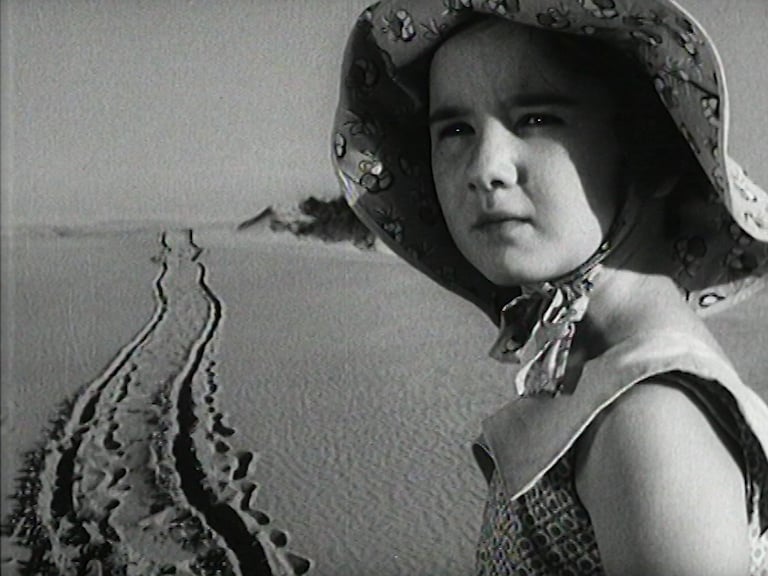
Two young sisters, Sally and Roberta, have left their home for the Birdsville Track to get help for their mother. They have their dog, a bottle of water, and a wheeled cart in tow. The youngest picks up her recorder and plays a simple melody while they cross the desert.
When they come across their own tracks, Sally realises they are lost. Not wanting to alarm her younger sister, they keep walking. Sally is forced to leave their dog behind after discovering they are low on water and as she ties the dog under a tree, her sister continues to play on her recorder unperturbed. As the children continue under the hot sun, the narration reveals that they vanish, their tracks disappearing under the windblown sand.
Two young sisters, Sally and Roberta, have left their home for the Birdsville Track to get help for their mother. They have their dog, a bottle of water, and a wheeled cart in tow. The youngest picks up her recorder and plays a simple melody while they cross the desert.
When they come across their own tracks, Sally realises they are lost. Not wanting to alarm her younger sister, they keep walking. Sally is forced to leave their dog behind after discovering they are low on water and as she ties the dog under a tree, her sister continues to play on her recorder unperturbed. As the children continue under the hot sun, the narration reveals that they vanish, their tracks disappearing under the windblown sand.
- NFSA IDZT0W0FDR
- TypeFilm
- MediumMoving Image
- FormFeature Film, Documentary
- Duration1 hr, 2 mins
- GenresDocudrama, Indigenous themes or stories, Indigenous as subject
- Year1954
- DirectorJohn HayerWritersRoland Robinson, Janet Heyer, Douglas Stewart and John HeyerOriginal MusicSydney John Kay
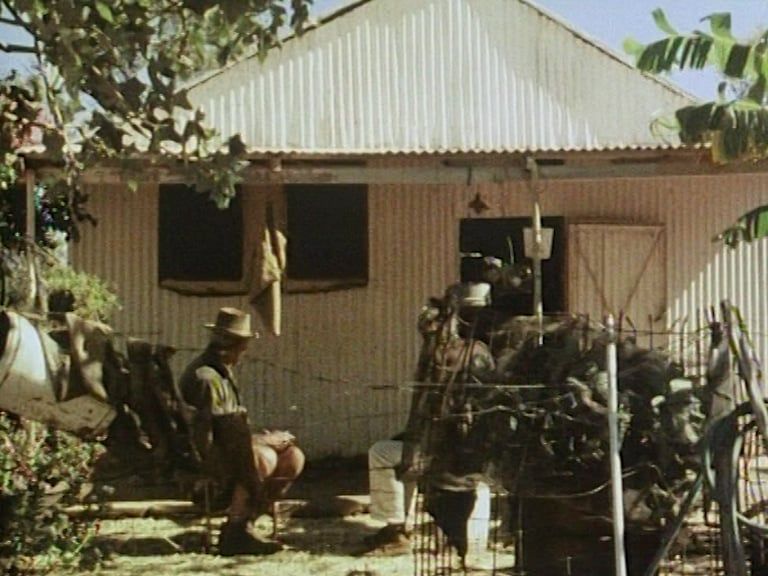
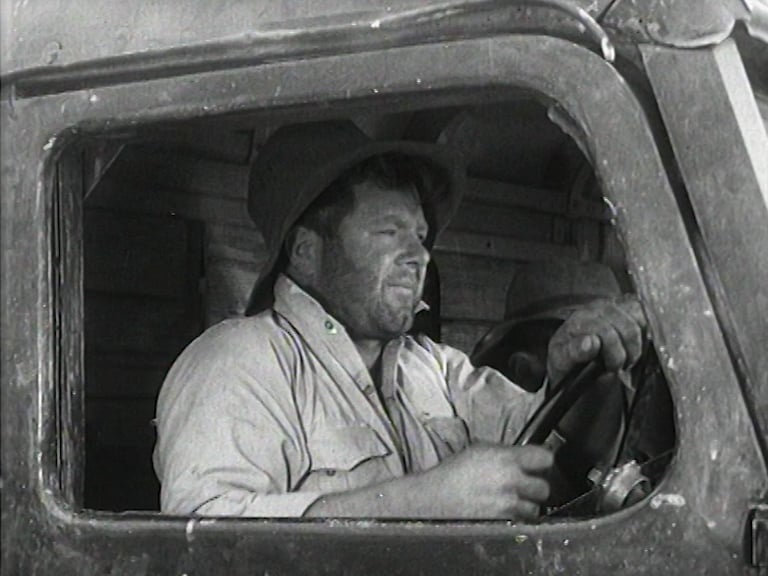
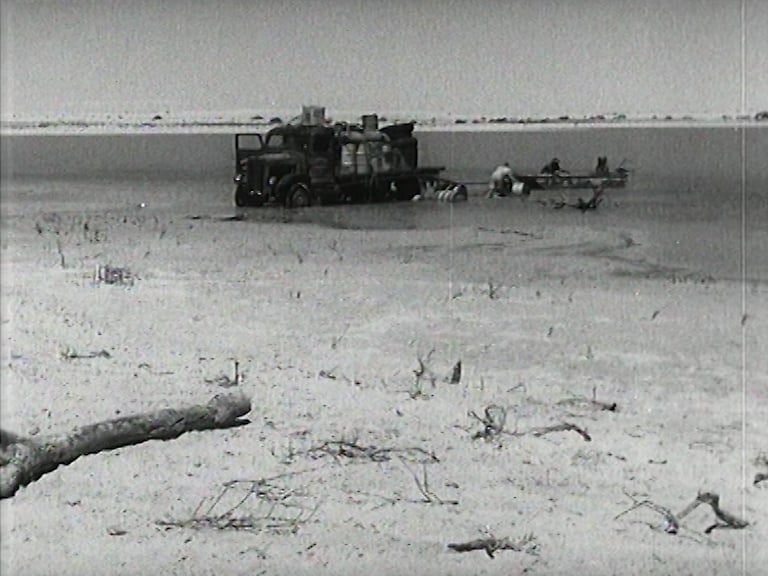
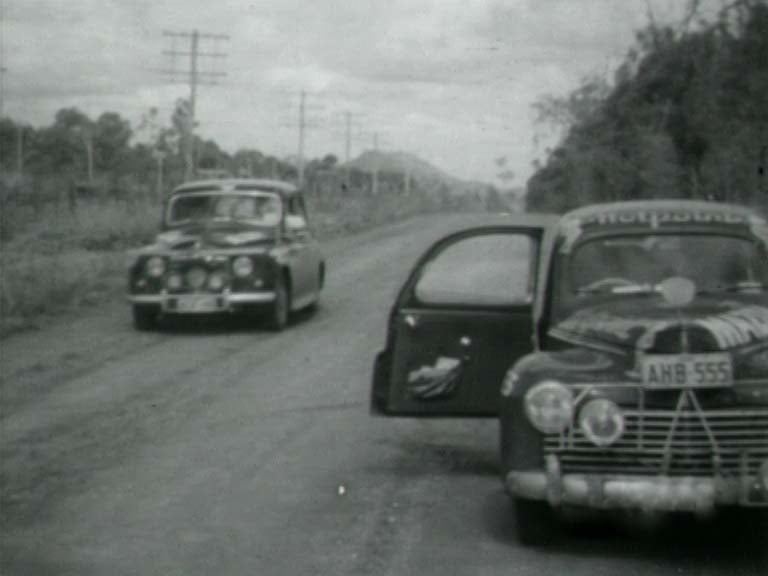
This black-and-white clip shows staged scenes of outback country – cattle being driven across the desert, an Aboriginal camp, prehistoric fossils and scattered human and animal bones – as a voice-over describes the history of the Birdsville Track, including the trading activities of Indigenous Australians and a reading from Edward Eyre’s diary. Tom Kruse, Her Majesty’s Royal Mailman, appears in his truck, stops to check on his load and on the welfare of a young passenger, Paddy, chats with his other passenger, William Henry Butler, and sets off again.
Educational value points
- This clip is from The Back of Beyond, a documentary that incorporates elements of documentary-drama, including staged dramatised scenes and a lyrical theatrical narration. The juxtaposition of eerie music, dramatic and poetic narration and sweeping cinematography stretched the limits of the objective and factual style of Australian documentary filmmakers at the time, to the extent that The Back of Beyond was often categorised as an ‘art film’.
- To a modern audience the theatrical cadence and poetic use of language in the voice-over narration appears melodramatic. The poet Douglas Stewart (1913–85) was brought onto the project to give a lyrical tone to the script. Some film damage and possibly the desire for more ‘polished’ voices meant that the voices of Tom Kruse and other characters were revoiced in the studio by actors, which added to the theatricality of the soundtrack.
- Filmmaker and writer Ross Gibson says the documentary sets up ‘the folklore of the outback as an alienating, menacing environment … an insignia of threat which comes to nothing’ (http://www.mcc.murdoch.edu.au). While the initial images, music and narration played into then current fears and mythology about the outback, the arrival of cheery Tom Kruse and his passengers brings a human dimension into what appears an inhospitable environment.
- The clip shows the harsh terrain around Mount Hopeless and the surrounding desert that the early European explorers Eyre and Sturt may have travelled through. Edward Eyre (1815–1901) discounted the notion of an inland sea and advised Charles Sturt (1795–1869) against his journey. However, Sturt’s expedition set out in August 1844. The clip shows various fossils, playing on the irony that the explorers were ‘12 million years too late’ to find the inland sea.
- The presence of Paddy, a young Aboriginal child travelling on the top of the truck, could be seen to challenge the narrator’s assertion that Indigenous Australians were a ‘vanishing race’. By the 1950s when the documentary was made the commonly held belief that Indigenous Australians would no longer exist had been largely discounted. Instead, during this decade, a policy of assimilation was adopted by the Australian and all state governments.
- A legend of the outback, Esmond Gerald (Tom) Kruse (1914–) delivered mail for 27 years to isolated homesteads along the Birdsville Track. He was renowned for always getting the mail through, overcoming floods, dust storms and mechanical breakdowns. Kruse was awarded an Order of the British Empire (MBE) in 1955 for services to the people of the Australian outback and continued delivering mail until the early 1960s.
- Since the late 1860s mail and other supplies had been delivered to people along the Birdsville track from Marree in South Australia to Birdsville in western Queensland – 517 km one way. The arrival of the railway in Marree and the SA Government’s drilling of ten bores at intervals of 50 km (between 1890 and 1916) established the Birdsville Track as Australia’s greatest droving route. Since 1970 the mail has been delivered by air.
- The Back of Beyond gave audiences a glimpse of outback Australia. The documentary, made in 1952 by John Heyer (1916–2001) for the Australian Shell Film Unit, was first screened in 1954 at the Marree Town Hall (NSW). The film won the Grand Prix Assoluto at the Venice Film Festival in 1954. From 1954 to 1955 an estimated 750,000 people saw it – around 10 per cent of the population of Australia at that time.
By Poppy De Souza
This is one of the ‘tales and legends of the track’, as the narrator says. This powerful scene (the only one told in flashback) taps in to 19th century settler anxieties about the dangers of Australia’s interior, the bush and the outback. Stories of disappearing children are sprinkled throughout Australian literature and more recently film, and have become part of modern folklore. The scene here recalls two iconic feature films, Nicholas Roeg’s Walkabout (1971) and Peter Weir’s Picnic at Hanging Rock (1975). While the abandoned children in Walkabout make it out of the desert alive, the girls at Hanging Rock follow the same fate of Sally and Roberta – swallowed by the landscape, they vanish forever.
Need to license this item? A/V professionals and researchers can shortlist licensing enquiries via our NFSA Pro catalogue search and membership.
Collections to explore
.jpg?w=320&h=240&auto=format)
Documentary
.jpg?w=320&h=240&auto=format)
.jpg?w=320&h=240&auto=format)
.jpg?w=320&h=240&auto=format)
Outback

1950s
Start your own collection
A free Your Stuff account allows you to save, organise and share your favourite videos, audio and stories.
.jpg?w=640&h=480&auto=format)

.jpg?w=640&h=480&auto=format)
.jpg?w=640&h=480&auto=format)
.jpg?w=640&h=480&auto=format)


.jpg?fp-x=0.4791666666666667&fp-y=0.37378472222222225&w=640&h=485&fit=crop&crop=focalpoint&auto=format)
.jpg?rect=4,0,760,576&w=640&h=485&fit=min&auto=format)
.jpg?fp-x=0.58544921875&fp-y=0.56103515625&w=640&h=485&fit=crop&crop=focalpoint&auto=format)
.jpg?rect=4,0,760,576&w=640&h=485&fit=min&auto=format)