Dirty Deeds: 'Murder suicide'
2002
Dirty Deeds: 'Murder suicide'
2002
- NFSA ID7WCMQ02S
- TypeFilm
- MediumMoving Image
- FormFeature Film
- Duration1 hr, 35 mins
- GenresCrime, Comedy
- Year2002
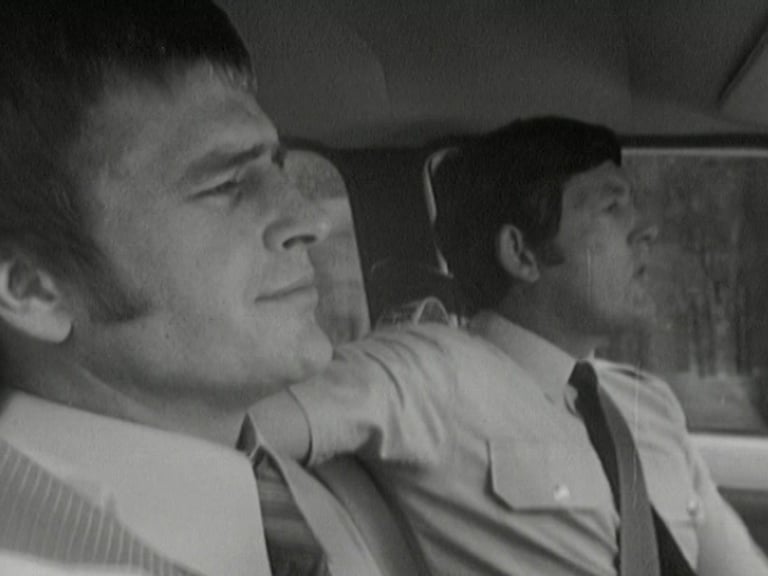
At the club, Barry (Bryan Brown) and Darcy (Sam Worthington) shift the bodies of two men that Barry has just shot. Detective Sergeant Ray (Sam Neill) arrives. The policeman is Barry’s main paid fixer of problems. Back in the outback the next morning, Barry visits the two American gangsters, Tony (John Goodman) and Sal (Felix Williamson) in the police lock-up. Tony tells Sal why their plan to take over the poker machine trade in Australia won’t work. Barry’s wife Sharon (Toni Collette) warns him about his girlfriend (Kestie Morassi).
Notes by Paul Byrnes
At the club, Barry (Bryan Brown) and Darcy (Sam Worthington) shift the bodies of two men that Barry has just shot. Detective Sergeant Ray (Sam Neill) arrives. The policeman is Barry’s main paid fixer of problems. Back in the outback the next morning, Barry visits the two American gangsters, Tony (John Goodman) and Sal (Felix Williamson) in the police lock-up. Tony tells Sal why their plan to take over the poker machine trade in Australia won’t work. Barry’s wife Sharon (Toni Collette) warns him about his girlfriend (Kestie Morassi).
Notes by Paul Byrnes
- NFSA ID7WCMQ02S
- TypeFilm
- MediumMoving Image
- FormFeature Film
- Duration1 hr, 35 mins
- GenresCrime, Comedy
- Year2002
- Production companiesHaystack Productions, New Town FilmsProducersBryan Brown, Deborah BalderstoneExecutive producersXavier Marchand, Kris NobleDirector, writerDavid CaesarMusicTim Rogers, Paul HealyMake-up artistVivien MephamCast (alphabetical)Bryan Brown, Toni Collette, Andrew S Gilbert, John Goodman, William McInnes, Kestie Morassi, Sam Neill, Garry Waddell, Felix Williamson, Sam Worthington
Tony’s speech rhymes with Darcy’s earlier explanation of why the Americans won’t win in Vietnam – a way of suggesting that Barry has been running a form of guerrilla warfare against the mafia incursions on his territory.
Dirty Deeds synopsis
Sydney, 1969. Barry Ryan (Bryan Brown), affable family man and gangster, controls most of the city’s booming poker machine trade when the US mafia decides it wants to take over his patch. Barry’s nephew Darcy (Sam Worthington), just back from serving in Vietnam, joins his uncle’s crew as the bullets start flying. Hoping to avoid a war, Ryan invites the two mafia emissaries on a pig-shooting trip to the outback. Tony (John Goodman), older and wiser of the two, wants to make a deal, but hothead Sal (Felix Williamson) prefers to shoot people. Barry’s wife Sharon (Toni Collette) helps her husband decide what to do.
Dirty Deeds curator’s notes
Dirty Deeds was an ambitious project – an attempt to make a modern, mainstream gangster film, but in a vernacular Australian style. The period setting points to the film’s underlying questions about Australia’s cultural identity – it is about the point at which Australia’s relationship with the US is about to change forever.
The young character Darcy has returned from taking part in the US-led war in Vietnam. He declares that the US won’t win that war, because they would have to kill every man, woman and child in Vietnam. Barry Ryan’s own campaign against US aggression becomes a kind of guerrilla war too, in which John Goodman’s character comes to the same conclusion – Australian crime is too hard to penetrate because they’re all in it together. At the same time, the film suggests that the tide of Americanisation was nevertheless irresistible – these characters haven’t even heard of pizza. Modern audiences under a certain age in Australia probably found it difficult to believe that there was a time when we didn’t have pizza.
The film was partly inspired by an infamous photograph, which shows a prominent Sydney criminal, the late Lennie McPherson, on a pig-shooting trip with two American mafiosi in Northern NSW in the late 1960s. The plot is a supposition, based on extensive research, rather than fact. The Roosevelt Club did exist, but it was closed down in 1944, for example. The influx of money that came with American servicemen on leave – in both the Second World War and the American war in Vietnam – had far-reaching effects on Australian crime, though, especially in the drug trade in the late 1960s in Kings Cross, the area in which the first half of the film is set.
Notes by Paul Byrnes
Education notes
This clip shows Barry Ryan (Bryan Brown) at Sydney airport, welcoming home his nephew Darcy (Sam Worthington), who has just returned from service in Vietnam. Barry introduces his crew, ‘Hollywood’ Riley (William McInnes) and Norm (Andrew S Gilbert), and says that he might have a job for Darcy. They drive away to the soundtrack of the Seekers’ version of ‘Oh Sinner Man’. Darcy tells Barry’s girlfriend, Margaret (Kestie Morassi), that the Americans cannot win the war in Vietnam. Meanwhile, Mafia members Tony (John Goodman) and Sal (Felix Williamson) check into the Gazebo Motel in Kings Cross and are annoyed that there is no colour television.
Educational value points
- The clip shows scenes from Dirty Deeds, a film inspired by events that occurred in the Sydney crime scene in the late 1960s. Lenny McPherson (1921–96), also known as ‘Mr Big’, was the most powerful crime figure in Sydney. He attempted to facilitate the forming of close ties between himself, other leading Australian criminals and the US Mafia. In 1969, McPherson held a meeting with Mafia hit man Joseph Dan Testa in Australia. The final scenes in this clip show Mafia boss Tony soon after his arrival in Australia.
- The clip raises the issue of contact between the US and Australian cultures. Allies in war, including the Second World War and the Vietnam War, Australian and US soldiers mixed both at home and in theatres of war. In this clip, newly arrived Americans are annoyed by what they see as some backward aspects of Australian culture and one of the locals is equally puzzled by some US customs, such as tipping. Australian vernacular language and the version of ‘Oh Sinner Man’ released by popular Australian band the Seekers are both featured.
- The young man returning from Vietnam portrayed in this clip could have been conscripted into active service. Conscription for military service was reintroduced in Australia in 1964 and was based on a lottery draw of birth dates for 20-year-old males. This followed the passing in the same year of the National Service Act, which introduced compulsory military service, mandating that 20-year-old males carry out full-time service for two years followed by three years in the Army Reserve. The Act was amended in May 1965 to oblige national servicemen to serve overseas, and 19,450 national servicemen were sent to Vietnam.
- The clip suggests a strong opposition to the war in Vietnam. Many Australians believed that Australia should not have become involved in the war, and by 1968 there was strong opposition being expressed in protests and moratorium marches. People protesting against the war often made no distinction between the war itself and the young soldiers, many of whom had been unwillingly conscripted and forced to fight in it. Young Australian conscripts returning from service in Vietnam were not welcomed back as heroes returning from war, but were shunned and sometimes attacked by some Australians. Many Vietnam veterans were made to feel ashamed of their military service and became alienated and embittered.
- The film is set in the 1960s, and its highly stylised look evokes the music, dress, architecture and decor of the period. Director David Caesar, production designer Chris Kennedy, costume designer Tess Schofield, and cinematographer Geoff Hall created the look of the film. The Australian men wear thin-lapelled suits and pork-pie hats, reminiscent of the Australian television series Homicide (1964–75) and Division 4 (1969–75). The contemporary music, the lighting, which has a sharp, cartoonish look, the 1960s cars and the bright colours of the motel room’s decor all create a bright 1960s mood.
- Bryan Brown (1947–) coproduced Dirty Deeds and was the lead actor. His first film was The Love Letters from Teralba Road (1977) and other films in which he has appeared include Newsfront (1978), Breaker Morant (1980), F/X (1985), Gorillas in the Mist (1988), Cocktail (1988) and Two Hands (1999). He has appeared in the television series A Town Like Alice (1981), The Shiralee (1987), Twisted Tales (1996) and Two Twisted (2006), and was also producer of the last two.
- Dirty Deeds (2002) was written and directed by David Caesar, who graduated from the Australian Film Television and Radio School in 1987. He started his film career with documentaries such as Body Work (1988), which explored the funeral industry. He has also written and directed the feature films Greenkeeping (1992), Idiot Box (1996) and Mullet (2000). He has also directed Australian television programs such as Twisted Tales (1996), Stingers (1998) and RAN: Remote Area Nurse (2006).
Education notes provided by The Learning Federation and Education Services Australia
Need to license this item? A/V professionals and researchers can shortlist licensing enquiries via our NFSA Pro catalogue search and membership.
Collections to explore

2000s
.jpg?w=100&h=75&auto=format)
.jpg?w=100&h=75&auto=format)
.jpg?w=100&h=75&auto=format)
Crime drama
Sydney
Start your own collection
A free Your Stuff account allows you to save, organise and share your favourite videos, audio and stories.


.jpg?w=640&h=480&auto=format)
.jpg?w=640&h=480&auto=format)
.jpg?w=640&h=480&auto=format)


