Conquest Of The Pacific
1928
Conquest Of The Pacific
1928
- NFSA IDFHGRK3ZH
- TypeFilm
- MediumMoving Image
- FormDocumentary
- GenresSilent film
- Year1928
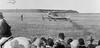
The Southern Cross, Sir Charles Kingsford Smith (Smithy) and his crew are seen here arriving in Brisbane on 9 June 1928 along with the crowd of 15,000 people who had gathered to witness their arrival as the first to have flown the Pacific Ocean.
This was the flight which made the Southern Cross famous. While in America Smithy purchased a three-engine Fokker F.VIIb second-hand from fellow Australian and Arctic explorer Sir Hubert Wilkins, without engines. With new engines installed he then set out in the ‘Old Bus’ (as he called it) to cross the Pacific along with Charles Ulm (co-pilot) and Americans Harry Lyon (navigator) and Jim Warner (radio operator) .
Departing Oakland, California on 31 May 1928 they flew 11,585 kilometres (mostly over water) via Hawaii and Suva to Brisbane’s Eagle Farm aerodrome in a flying time of 83 hours and 50 minutes. They encountered severe storms en route which only added to the danger of flying and navigating over the ocean. Flying in an open cockpit was so noisy that the crew had to write down messages and course directions.
After crossing the Pacific, Smithy and the Southern Cross accomplished a number of significant flights. They were first to fly non-stop over the Australian Continent and first to cross the Tasman, after an east-west crossing of the Atlantic. Upon returning to Oakland, California they became the second to circumnavigate the world but the first to do it including both hemispheres.
Today the Southern Cross is on display at Brisbane International Airport.
The Southern Cross, Sir Charles Kingsford Smith (Smithy) and his crew are seen here arriving in Brisbane on 9 June 1928 along with the crowd of 15,000 people who had gathered to witness their arrival as the first to have flown the Pacific Ocean.
This was the flight which made the Southern Cross famous. While in America Smithy purchased a three-engine Fokker F.VIIb second-hand from fellow Australian and Arctic explorer Sir Hubert Wilkins, without engines. With new engines installed he then set out in the ‘Old Bus’ (as he called it) to cross the Pacific along with Charles Ulm (co-pilot) and Americans Harry Lyon (navigator) and Jim Warner (radio operator) .
Departing Oakland, California on 31 May 1928 they flew 11,585 kilometres (mostly over water) via Hawaii and Suva to Brisbane’s Eagle Farm aerodrome in a flying time of 83 hours and 50 minutes. They encountered severe storms en route which only added to the danger of flying and navigating over the ocean. Flying in an open cockpit was so noisy that the crew had to write down messages and course directions.
After crossing the Pacific, Smithy and the Southern Cross accomplished a number of significant flights. They were first to fly non-stop over the Australian Continent and first to cross the Tasman, after an east-west crossing of the Atlantic. Upon returning to Oakland, California they became the second to circumnavigate the world but the first to do it including both hemispheres.
Today the Southern Cross is on display at Brisbane International Airport.
- NFSA IDFHGRK3ZH
- TypeFilm
- MediumMoving Image
- FormDocumentary
- GenresSilent film
- Year1928
- DesignerBert Ives
Need to license this item? A/V professionals and researchers can shortlist licensing enquiries via our NFSA Pro catalogue search and membership.
Collections to explore
Pilots
1920s

Space exploration
Start your own collection
A free Your Stuff account allows you to save, organise and share your favourite videos, audio and stories.


