Bad Boy Bubby: How the other half eats
1993
Bad Boy Bubby: How the other half eats
1993
- NFSA IDZECYJD8E
- TypeFilm
- MediumMoving Image
- FormFeature Film
- GenresDrama
- Year1993
- WARNING: This clip contains coarse language
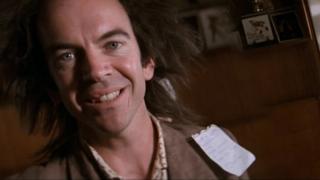
Bubby (Nicholas Hope) encounters a dog, a printing shop and a cake shop. In each place his senses are overwhelmed. When he mimics the sound of an upper-class woman (Celine O’Leary) in the cake shop, she takes him under her wing. In her car, he touches her breast – as he does with all the women he meets. Bubby’s mother never explained that this is not done. He has never ridden in a car before, but he has heard how young men in cars shout abuse, so that’s what he does when they stop at an intersection. A policeman doesn’t find it funny. Summary by Paul Byrnes.
- WARNING: This clip contains coarse language
Bubby (Nicholas Hope) encounters a dog, a printing shop and a cake shop. In each place his senses are overwhelmed. When he mimics the sound of an upper-class woman (Celine O’Leary) in the cake shop, she takes him under her wing. In her car, he touches her breast – as he does with all the women he meets. Bubby’s mother never explained that this is not done. He has never ridden in a car before, but he has heard how young men in cars shout abuse, so that’s what he does when they stop at an intersection. A policeman doesn’t find it funny. Summary by Paul Byrnes.
- NFSA IDZECYJD8E
- TypeFilm
- MediumMoving Image
- FormFeature Film
- GenresDrama
- Year1993
- Production companyBubby, Fandango AustraliaProduced byRolf de Heer, Giorgio Draskovic, Domenico ProcacciAssociate ProducerDavid LightfootDirectorRolf de HeerWriterRolf de HeerMusicGraham TardifAcknowledgementsProduced with the assistance of the film Finance Corporation Australia and the South Australian Film Corporation
Nicholas Hope’s performance is quite astonishing in the role of Bubby. He was an unknown actor when de Heer saw him in a South Australian short film. This was his first feature and it was shot in sequence to help him achieve his performance. It’s an extremely difficult role to make credible – not just because Bubby is so childlike and pre-verbal, but also because we have to see the native intelligence beneath his lack of worldly knowledge. Hope manages to convey all this without becoming sentimental or cloying. A number of people have noted that the film bears some resemblance to the story of Kaspar Hauser, a German child who turned up on a street in Nuremberg in 1828. He could barely talk, although he appeared to be in his late teens. His story was turned into a film in 1974 by Werner Herzog (The Enigma of Kaspar Hauser), but de Heer has said he has never seen that film.
Bad Boy Bubby synopsis
Bubby (Nicholas Hope) has spent all of his 35 years locked in one room. His mother (Claire Benito) feeds and washes him like a baby, but she also uses him for sex. She has raised him to believe that if he goes outside the door – which is always locked – he will die from the poisoned air. She leaves him alone for long periods where he believes Jesus is watching him. Bubby’s only companion is a cat, which he torments. He is not malicious, more a naughty child. Bubby’s world expands with the return of his father, whom he has never met.
Pop (Ralph Cotterill) is a drunken conman dressed as a priest. When he attacks Bubby in a drunken rage, Bubby puts him to sleep, with cellophane over his head, as he did to the cat. He does the same to his mother, then leaves the room. He has guessed that the air will not kill him, but he is unprepared for the world outside. He is seduced by a Salvation Army girl (Natalie Carr), beaten by policemen, thrown in jail and raped by a prisoner and set upon and kicked by women who think he’s a pervert. He also makes friends with the members of a pub rock band who turn him loose as their singer, and he is adopted by a kindly nurse called Angel (Carmel Johnson) who looks after people with severe physical difficulties. Eventually, Bubby and Angel become lovers. They have children and settle down. Bubby finds a place in the world.
Bad Boy Bubby curator's notes
Bad Boy Bubby was conceived as an experiment on virtually every level. Rolf de Heer worked on the script over a period of ten years, pushing it further into extremes with each redraft. He shot it in sequence, and with 32 different cinematographers – one for each new location – and recorded it in binaural sound, using radio microphones taped to the side of the head of Nicholas Hope, the actor playing Bubby. The film was going to be shot on weekends for $400,000, using out-of-date film stock, until an Italian producer, Domenico Procacci, read the script. He contributed the $400,000 but insisted the film be shot on good stock. It was eventually shot over nine weeks for a total budget of around $800,000. The film was shown in competition in Venice, where it won five prizes. ‘It tore the place apart’, Rolf de Heer said later.
He conceived the film as a parable about child abuse, but the material was too dark to use a child actor, so Bubby became an adult man who has been mistreated for 35 years. Bubby is an innocent. Even though he actually kills four people in the film, he is incapable of understanding his crimes. The first third of the film, inside the dungeon where he is raised, establishes a crucial reality. When Bubby eventually leaves there, we believe in his sensory deprivation, and that everything he experiences is new. We also know that he’s smarter than he looks. The film creates a lot of enjoyably vulgar comedy out of his interactions with the world around him. It’s not stated that this is Adelaide, but de Heer presents a view of his adopted home city that’s so harsh it’s funny.
De Heer was born in Holland and came to Australia at the age of eight, in 1959. Bubby’s first impressions of the city could have something to do with that experience of a child in a new country, although de Heer has always stressed that Bubby ‘is in no way anything to do with me … I have two parents who are terrific and I am doubly indebted to them for bringing me up mentally healthy – although some people have their doubts when they look at this film’.
Alongside the film’s low comedy, there is always a set of much larger questions, to do with existence and religion. Bubby has been raised with a terrible fear of God’s power and cruelty. Out in the wider world, he gets plenty of evidence of mankind’s cruelty, and the lack of piety of some in the church. In a church, he is drawn to the sound of the organ, which is being played by Norman Kaye, as a character known in the credits as The Scientist. This man is one of the few who show him kindness, but he also insists that there is no God, and that it’s Bubby’s duty to insult him. On the other hand, Bubby falls in love with Angel, who is a believer, and a good advertisement for Christian kindness (although she and Bubby have much in common in upbringing – her parents are religious maniacs who persecute her horribly).
The film’s most controversial aspect was not its depiction of cruelty towards a human, but the depiction of cruelty towards the cat. When the film was released in Italy, a coalition of animal rights groups tried to set up a boycott of Australian products, alleging that the cat was tortured and smothered in the film. Rolf de Heer has said that none of that is true; the cat scenes were carefully filmed, with a veterinarian and animal cruelty inspector on set. Nicholas Hope, in an on-stage interview included on the dvd of the film, says there were two cats, one of which became a pet of a crew member. The other was a feral cat that was put down by a vet after filming (as with most feral cats that are caught in Australia).
Notes by Paul Byrnes
Need to license this item? A/V professionals and researchers can shortlist licensing enquiries via our NFSA Pro catalogue search and membership.
Collections to explore
Disability
Feature film
Rolf de Heer
Start your own collection
A free Your Stuff account allows you to save, organise and share your favourite videos, audio and stories.


