The 8th Wonder of the World: Sydney Opera House sails
1973
The 8th Wonder of the World: Sydney Opera House sails
1973
- NFSA ID346BHA28
- TypeFilm
- MediumMoving Image
- FormDocumentary
- Duration28 mins, 44 secs
- GenresIndigenous themes or stories, Indigenous as subject
- Year1973
The exterior walls of the Sydney Opera House were inspired by the sails of the pleasure craft on the nearby harbour.
Good shots of the Opera House and surrounds, with the narration and music being very typical of the sponsored documentaries of the time.
Summary by Damien Parer.
The exterior walls of the Sydney Opera House were inspired by the sails of the pleasure craft on the nearby harbour.
Good shots of the Opera House and surrounds, with the narration and music being very typical of the sponsored documentaries of the time.
Summary by Damien Parer.
- NFSA ID346BHA28
- TypeFilm
- MediumMoving Image
- FormDocumentary
- Duration28 mins, 44 secs
- GenresIndigenous themes or stories, Indigenous as subject
- Year1973
- Production companyCinesound ProductionsExecutive producerHarold R DewsDevised and directed byWilliam M CartyCastJ Griffen-Foley
The 8th Wonder of the World synopsis
A documentary looking at the newly completed Sydney Opera House, produced at the time of the official opening in 1973. The film looks at the architecture, art and functions of the building.
Curator's notes
British Paints sponsored the documentary. It is well shot, straightforward, with narration and a specially composed orchestral score. This 30-minute film had a high budget, which permitted a six-month shoot.
Two other documentaries about the Opera House were made at the same time, Monster or Miracle and The Fifth Façade. Monster or Miracle, directed by a young Bruce Beresford is a stylish film worthy of the subject matter. The Fifth Façade is Film Australia’s celebratory film directed by Donald Crombie, the award winning feature film director and produced by Anthony Buckley, also an award winning feature film producer.
Notes by Damien Parer.
Education notes
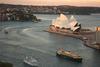
This clip shows multiple views of the newly constructed Sydney Opera House that draw attention to its setting, the uniqueness and beauty of its architecture and the technical achievement of its construction. There is a voice-over narration and the constantly changing images are accompanied by an orchestral music soundtrack featuring strings, brass and flute. The clip concludes with a shot looking from the Sydney Opera House towards the Sydney Harbour Bridge at sunset.
Educational value points
- The Sydney Opera House featured in this clip is one of Australia’s cultural icons. Like the Sydney Harbour Bridge and the new Parliament House in Canberra, it has come to symbolise Australian architecture. The distinctive 'sails’ of the Opera House make it an instantly recognisable Sydney landmark, rather like the Eiffel Tower in Paris or the Empire State Building in New York.
- The upbeat celebratory tone of the clip ignores the controversy that accompanied the building of the Opera House. Construction began in 1957 after the Danish architect Jørn Utzon was declared the winner of a worldwide competition. Construction was begun against the wishes of Utzon, who had not yet solved the engineering challenge of building the 'shells’.
- The film shows the building’s distinctive sail-like shells of the roof from every angle, displaying the beauty of their sculptural form and ingenuity of their design. It was the innovation and potential for visual effect of these 'sails’ that won the design competition for Utzon. However the design challenged engineering know-how and technology of the time. This contributed to the budget blow-out, the criticism Utzon received and his eventual withdrawal from the project.
- The clip features the most famous work of Jørn Utzon (1918–), who won the Sydney Opera House design competition in 1957 when he was a relatively unknown young Danish architect with few realised designs. The ten drawings that comprised his entry to the competition contained a revolutionary design concept, but it was not until 1966 that he solved the building’s structural challenges. After resigning from the project in 1966, he has never returned to Australia.
- The splendid setting of the Opera House on the end of a promontory and surrounded on three sides by the waters of Sydney Harbour, is celebrated in the clip. The site was well known to the local Aboriginal peoples. Bennelong, an Indigenous man employed as an interpreter by Captain Arthur Phillip, lived in a hut at the extreme end of the point, giving it its name. From 1902 to 1958 the point housed a tram shed, which was demolished to build the Opera House.
- Since its opening by Queen Elizabeth II in 1973 the Sydney Opera House has become one of the busiest performing arts centres in the world. Its five major performance spaces host some 3,000 events a year with audiences numbering around 2 million. The Concert Hall is the biggest and grandest of the theatres, seating 2,690 people, but there is also the smaller Opera Theatre, the Drama Theatre, the Playhouse and the Boardwalk.
- The Sydney Opera House was opened on 20 October 1973, 16 years after its architect Jørn Utzon won the international competition for its design and 26 years after Sir Eugene Goossens (1893–1962) proposed an Opera House be built on Bennelong Point. Goossens, resident conductor of the Sydney Symphony Orchestra, influenced New South Wales Premier, J J Cahill (1891–1959) to form the committee that selected the site and oversaw the competition for the design.
- The clip provides an example of a well-funded 1970s sponsored documentary with rich visuals and a specially commissioned musical score. The sponsor was British Paints. Owned by Orica, an Australian-based global company, British Paints saw benefit in associating itself with the opening of Australia’s most celebrated building until that time, the Sydney Opera House.
Education notes provided by The Learning Federation and Education Services Australia.
Need to license this item? A/V professionals and researchers can shortlist licensing enquiries via our NFSA Pro catalogue search and membership.
Collections to explore
1970s
Building and construction
Sydney Opera House
Start your own collection
A free Your Stuff account allows you to save, organise and share your favourite videos, audio and stories.


